
Modern web design is the practice of building websites optimized for usability, performance, and visual clarity so businesses can engage visitors and drive real results. The industry term for this approach is "user-centered design," and it covers everything from how fast a page loads to how easy it is to read on a phone. For small business owners, understanding what is modern web design means knowing which principles actually move the needle: responsive layouts, accessible content, Core Web Vitals performance targets, and component-based architecture. Get these right, and your website works as a 24/7 sales tool. Get them wrong, and visitors leave before they ever read your offer.
What are the core principles of modern web design?
Modern web design starts with one rule: fewer elements, better results. The most effective websites use fewer colors, fewer fonts, and fewer calls to action. Each reduction removes a decision point for the visitor and focuses attention on what matters most.
Typography is the second pillar. Clear heading hierarchy and comfortable line lengths do more for readability than any complex layout. A well-chosen typeface paired with consistent sizing tells visitors where to look and what to read next, without any extra instruction.
Performance is the third principle, and it is non-negotiable. Google's Core Web Vitals measure three specific signals:
- Largest Contentful Paint (LCP): How fast the main content loads. The target is under 2.5 seconds on mobile. Missing this standard harms both search rankings and conversion rates.
- Cumulative Layout Shift (CLS): How much the page jumps around while loading. A stable page builds trust; a shifting one frustrates visitors.
- Interaction to Next Paint (INP): How quickly the page responds to clicks and taps. Slow responses signal a broken experience.
Accessibility rounds out the core principles. Designing for assistive technologies from the start, rather than adding it as a final checklist, produces better results for every visitor, not just those using screen readers.
Pro Tip: Run your current site through Google's PageSpeed Insights before redesigning anything. The report shows exactly which Core Web Vitals you are failing and why, giving you a concrete starting point.
Purposeful animation belongs in this list too. Subtle transitions and scroll reveals improve the sense of responsiveness and guide users through content. Animation used for decoration alone slows pages down and distracts visitors from your primary message.
How do modern technologies support scalability and manageability?
The technology stack behind a website determines how easy it is to grow and maintain. Small business owners who choose the wrong platform early often pay for it later with expensive rebuilds and developer dependency.
-
Component-based design systems. Reusable coded components keep the visual design consistent as a site grows beyond 10–20 pages. Instead of rebuilding buttons, cards, and headers from scratch each time, you pull from a shared library. The result is a site that looks and behaves the same everywhere.
-
Headless CMS. A headless content management system separates content from presentation. This means a business owner can update text, images, and offers through a clean interface without touching code or waiting for a developer. Editorial flexibility is the direct business benefit.
-
Modern frontend frameworks. Tools like Next.js and React power fast, reliable websites. They handle performance optimizations automatically and support the kind of component architecture described above.
-
Reliable hosting platforms. Fast content delivery networks and edge hosting reduce load times globally. A slow host undermines every other design decision you make.
-
Avoiding legacy platforms. Older website builders and template systems limit what you can build and increase maintenance costs over time. Migrating away from them is painful, but staying on them is more expensive in the long run.
Pro Tip: If you cannot update your own website content without calling a developer, your platform is working against you. Editorial independence is a business requirement, not a luxury.
Design systems work best when they exist as both code libraries and documentation. That combination keeps designers and developers aligned and makes onboarding new team members far faster.
Why is responsive and accessible design crucial for modern websites?
Responsive design is no longer a feature. It is a baseline expectation. Modern responsive design adapts to screen size, orientation changes, zoom levels, and input methods including touch, keyboard, and mouse. A site that only adjusts width fails visitors using tablets in landscape mode or keyboards instead of touchscreens.
Accessibility follows four principles, known as WCAG's POUR framework:
- Perceivable: Content must be visible or audible to all users, including those with visual impairments.
- Operable: Every function must work via keyboard, not just mouse clicks.
- Understandable: Language and navigation must be clear and predictable.
- Robust: The site must work with current and future assistive technologies.
Accessibility treated as a design constraint from the beginning, rather than a retrofit, produces cleaner code, better SEO, and a wider audience. Search engines read websites similarly to screen readers. A site built for accessibility is also built for discoverability.
Dark mode is now part of this conversation. Dark-mode-first design meets current user preferences and reduces eye strain, but it also forces designers to reconsider color contrast ratios across every component. Getting contrast right in dark mode means getting it right everywhere.
The business case for accessibility is straightforward. Accessible websites reach more people, satisfy legal compliance requirements in many jurisdictions, and rank better in search results. Treating accessibility as optional is leaving revenue on the table.
Which modern web design trends should small businesses consider in 2026?
The trends worth adopting in 2026 share one quality: they serve the user first and look good second.

Bento grid layouts organize content into modular, card-based sections. They work especially well on mobile because each card scales independently. The layout communicates structure without requiring the visitor to read everything.
Sustainable web design is gaining traction as a real performance strategy. Reducing unnecessary scripts and optimizing images improves load times, lowers data usage, and reduces the carbon footprint of a site. Leaner pages rank better and cost less to host.
Bold typography and generous whitespace have replaced the trend of cramming content above the fold. Large, confident type signals authority. Whitespace gives content room to breathe and directs the eye to what matters.
Micro-interactions are small animations triggered by user actions: a button that changes color on hover, a form field that highlights on focus, a menu that slides in smoothly. These details make a site feel polished and responsive without adding visual noise.
The table below shows how these trends map to specific business benefits:
| Trend | Primary benefit |
|---|---|
| Bento grid layouts | Faster content scanning on mobile |
| Sustainable design | Faster load times, lower hosting costs |
| Bold typography | Stronger visual hierarchy, clearer messaging |
| Micro-interactions | Higher perceived quality and user trust |
| Dark mode support | Broader audience reach, reduced eye strain |
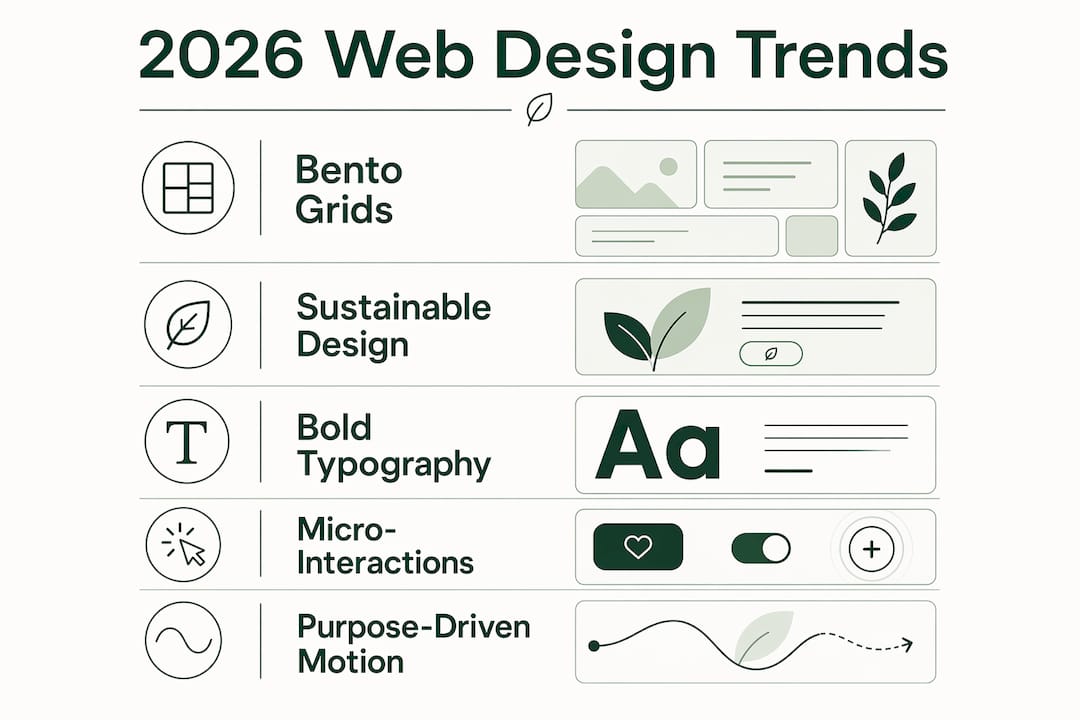
Purpose-driven motion is the thread connecting all of these trends. Animation that communicates information, such as a progress indicator or a confirmation checkmark, earns its place. Animation that exists purely for style slows the page and distracts the visitor.
How can small business owners implement modern web design effectively?
Implementation does not require a large budget or a development team. It requires the right priorities and the right tools.
- Start with a content audit. List every page on your current site and decide what stays, what gets cut, and what needs rewriting. A modern design built on outdated content will not perform.
- Choose a platform that gives you editorial control. You should be able to update text, swap images, and add pages without developer help. If you cannot, switch platforms before redesigning.
- Test performance before and after every major change. Use Google's PageSpeed Insights or Lighthouse to measure Core Web Vitals. Set a target of LCP under 2.5 seconds and track it consistently.
- Run an accessibility audit. Free tools like WAVE or axe identify the most common issues in minutes. Fix high-contrast failures and missing alt text first, as these affect the most users.
- Use AI-assisted builders for speed. Platforms that generate design systems and page structures with AI guidance reduce the time from idea to live site dramatically. Talivo, for example, can convert an existing Google Maps listing or outdated website into a modern, mobile-first site without requiring you to write copy or hire a designer.
Pro Tip: Do not redesign your entire site at once. Redesign your homepage and one key landing page first, measure the results for 30 days, then apply what you learn to the rest of the site.
Modern web design must be content-driven, not template-driven. The best platform in the world will not help if the content does not guide visitors toward a clear action. Design and content strategy belong together from day one.
Key Takeaways
Modern web design succeeds when it combines visual clarity, fast performance, accessible structure, and editorial flexibility into a single, consistent system.
| Point | Details |
|---|---|
| Minimalism drives results | Fewer colors, fonts, and calls to action focus visitor attention and improve conversions. |
| Core Web Vitals are non-negotiable | LCP under 2.5 seconds on mobile directly affects search rankings and user retention. |
| Accessibility expands your audience | Designing for assistive technologies improves SEO, legal compliance, and overall reach. |
| Editorial independence matters | Business owners should update content without developer help to stay agile. |
| Trends should serve users first | Bento grids, sustainable design, and micro-interactions work because they improve usability, not just aesthetics. |
What I have learned from watching small businesses get web design wrong
Most small business owners I have worked with make the same two mistakes. They either over-invest in visual polish before fixing performance, or they under-invest in content structure and wonder why visitors do not convert.
A beautiful website that loads in five seconds is a liability, not an asset. Visitors form opinions in milliseconds. A slow load time communicates unreliability before a single word is read. I have seen businesses spend thousands on redesigns that scored worse on Core Web Vitals than the sites they replaced.
The second mistake is treating accessibility as a legal checkbox rather than a design advantage. Every accessibility improvement, better contrast, cleaner navigation, descriptive alt text, also improves the experience for every visitor. It is not a cost. It is a multiplier.
The businesses that get web design right treat their website as a living system, not a finished product. They update content regularly, test performance after every change, and build on platforms that give them control. They also recognize that editorial flexibility is a competitive advantage. When you can publish a new offer or update your pricing in ten minutes without calling anyone, you move faster than competitors who cannot.
The future of web design belongs to businesses that understand this. Design is not decoration. It is the structure through which your business communicates its value. Get the structure right, and everything else follows.
— jacopo
How Talivo helps you build a modern website without the complexity
Getting a modern website live used to mean hiring a designer, a developer, and a copywriter, then waiting weeks for the result.
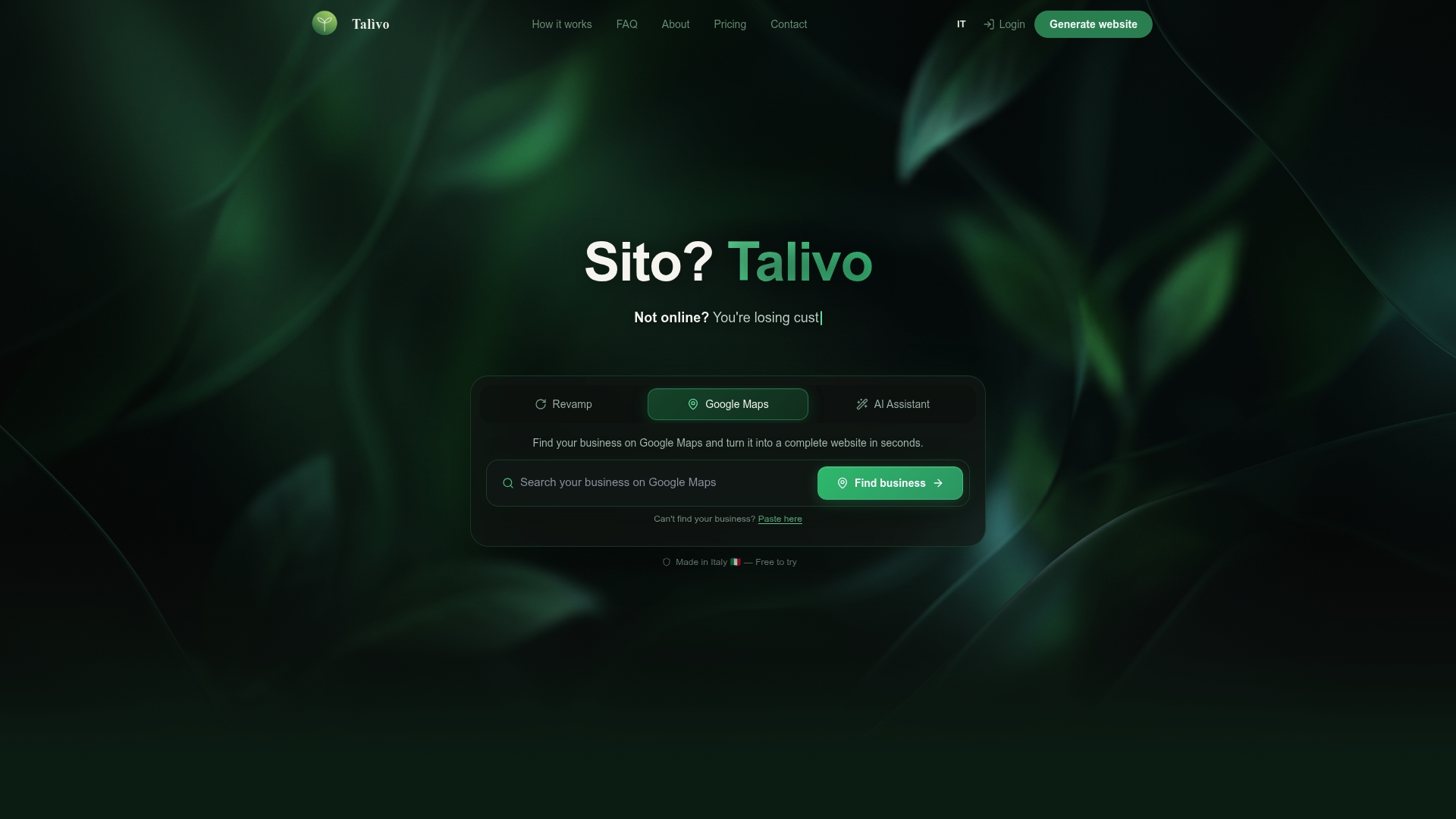
Talivo changes that equation entirely. Paste in your existing website URL and Talivo rebuilds it with a modern, mobile-first design while keeping all your content and images intact. If you are listed on Google Maps but have no website, Talivo converts that listing directly into a full site, complete with your photos, reviews, and contact details. New businesses can describe what they do and let Talivo's AI guidance generate a complete site from scratch. Every site Talivo builds follows modern design principles including performance, accessibility, and responsive layouts. Visit Talivo to see how fast a professional website can actually be.
FAQ
What is modern web design in simple terms?
Modern web design is the practice of building websites that are fast, easy to use, and accessible on any device. It prioritizes performance, clear visual hierarchy, and content that guides visitors toward a specific action.
What makes a website modern in 2026?
A modern website meets Core Web Vitals performance targets, uses a responsive layout that adapts to all devices and input methods, supports accessibility standards, and gives the business owner editorial control without requiring a developer.
Why does responsive design matter for small businesses?
Responsive design ensures your website works correctly on phones, tablets, and desktops, including across zoom levels and keyboard navigation. A site that fails on mobile loses a significant portion of potential customers before they read a single word.
How do Core Web Vitals affect my business website?
Core Web Vitals measure load speed, visual stability, and responsiveness. Websites that meet these standards rank higher in Google search results and retain more visitors, which directly affects leads and sales.
Can I build a modern website without coding skills?
Yes. AI-assisted platforms like Talivo generate modern, accessible, mobile-first websites from an existing URL, a Google Maps listing, or a plain-language description of your business, with no coding required.