
What is a professional web presence, and why does it matter?
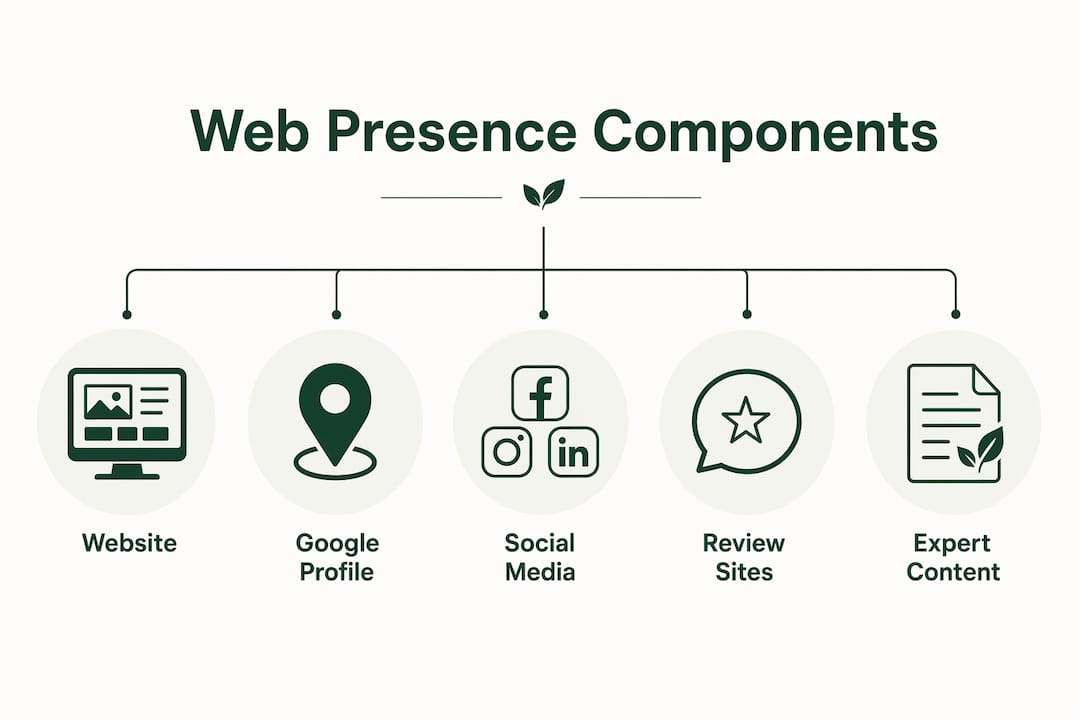
Your professional web presence is the full collection of digital assets that represent you or your business online. That means your website, Google Business Profile, social media accounts, review listings, and increasingly, the AI-generated summaries that platforms like Google Gemini and ChatGPT produce when someone searches your name. Together, these assets shape how a potential customer perceives you before they ever make contact.
Think of it this way: a prospect Googles your business name. What they find in the first ten seconds either builds confidence or raises doubt. A professional web presence is the collective online inventory that shapes how a business is perceived before any direct contact, and in 2026, that inventory now includes AI-generated brand summaries alongside traditional search results.
The core elements that make a presence genuinely professional:
- Consistent branding across every platform, including the same name, logo, colors, and tone
- Accurate business information that matches everywhere it appears
- Authoritative content that demonstrates expertise in your field
- A positive reputation built through reviews, testimonials, and press coverage
- AI-readable structure so that search engines and AI tools can correctly summarize who you are
For small business owners, this matters because customers now expect to verify a business digitally before spending money. A weak or inconsistent presence does not just look unprofessional. It signals that the business may not be legitimate.

Key components every strong web presence needs
Building a strong web presence is not about being everywhere at once. It is about owning the right assets and keeping them sharp. Here is what actually moves the needle.
Your website
Your website is your digital headquarters. It is the one place you fully control, and it needs to do more than look nice. At minimum, a professional site includes a clear home page, a detailed About page, a services or products page, a contact page with hours and location, and a mobile-friendly design. Schema markup, the structured data code that tells search engines exactly what your business does, helps both Google and AI platforms categorize you accurately.
Google Business Profile
Google Business Profile is the highest-leverage asset for any local business. A complete, consistent profile influences Google Maps results, the local search pack, and increasingly, AI-generated responses to local queries. Fill out every field, add photos, and keep your hours current.

Social media platforms
Not all platforms are equal for every business. A B2B consultant gets more traction on LinkedIn than on TikTok. A local bakery may find Instagram and Facebook far more effective. The rule is simple: go deep on the platforms your customers actually use, rather than spreading thin across all of them.
Review sites and directories
Yelp, Angi, and industry-specific directories extend your reach and credibility. According to BrightLocal, A large majority of consumers read online reviews for local businesses before making a decision. That number alone makes review management a core part of your presence strategy.
Content that demonstrates expertise
Blogs, case studies, LinkedIn articles, and press coverage all signal authority. For individual professionals, LinkedIn often outranks personal websites in executive name searches, and a Forbes byline or industry publication feature carries more weight than anything you publish on your own site.
Quick-reference component list:
- Professional website with schema markup and mobile optimization
- Google Business Profile, fully completed and regularly updated
- Active profiles on 1–2 social platforms where your audience lives
- Listings on relevant review sites and directories
- Blog or content hub demonstrating expertise
- LinkedIn profile for individual professionals
- Consistent name, address, and phone number across all listings
Why a professional web presence drives real business results
The business case for a strong online presence comes down to one reality: Google processes about 3.8 million searches per minute, and a large portion of those searches are people looking for local businesses and services. If your business does not appear, or appears inconsistently, you are invisible to that demand.
The benefits of getting this right are concrete:
- Higher trust and legitimacy. Customers who find a polished, consistent presence are far more likely to reach out. A disjointed or outdated presence triggers doubt before a conversation even starts.
- Better lead quality. Clear online branding filters your audience. People who contact you after reviewing your site, reviews, and social profiles already understand what you offer and are more likely to convert.
- Control over your narrative. A proactive presence means you shape what people find, rather than leaving it to chance reviews or outdated directory listings.
- Discoverability across channels. Appearing consistently across your website, Google, and social platforms multiplies the chances a prospect encounters you during their research phase.
- Influence on AI summaries. When ChatGPT or Google Gemini generates a summary about your business, it draws from the content you have published. A well-structured presence gives you input into those results.
3.8 million searches per minute happen on Google. For local businesses, search visibility is not a marketing bonus. It is the first filter between you and a potential customer.
The businesses that treat their web presence as a living asset, rather than a one-time setup, consistently outperform those that do not. A stale website or an unclaimed Google Business Profile is not neutral. It actively costs you opportunities.
How to create and maintain a professional web presence
Building this from scratch, or cleaning up what you already have, follows a clear sequence. Skip steps and the gaps show.
-
Clarify your digital identity. Decide on the exact name, tagline, and visual style you will use everywhere. This includes your logo, brand colors, and the tone of your writing. Inconsistency here is the most common mistake small businesses make.
-
Build or update your website. Focus on the pages that matter most: home, about, services, and contact. Write your About page as if a skeptical stranger is reading it. Add schema markup so search engines and AI tools can parse your business category, location, and offerings. Make sure the site loads fast and looks clean on a phone. If your current site is outdated, tools like Talivo can rebuild a website with AI from your existing URL or Google Maps listing in minutes, without requiring you to rewrite all your content.
-
Claim and complete your Google Business Profile. Go to Google Business Profile, claim your listing, and fill out every field. Add photos, set your hours, and write a clear business description. This single step has an outsized effect on local search visibility.
-
Standardize your business information everywhere. Your name, address, and phone number must be identical across your website, Google, Yelp, Facebook, and any other directory where you appear. Even small differences, like "St." versus "Street," can confuse search algorithms and reduce your ranking.
-
Choose your social platforms deliberately. Pick one or two based on where your customers spend time. Set up complete profiles with your logo, a consistent bio, and a link to your website. Then post regularly. Responding to comments matters as much as posting.
-
Collect and manage reviews. Ask satisfied customers to leave reviews on Google and any relevant platform. Respond to every review, positive or negative, professionally. This signals to both customers and search engines that your business is active and engaged.
-
Audit your presence quarterly. Search your own name and business name in Google. Look at what appears. Remove or correct outdated information. Check that your website still loads correctly and that all links work. This is the step most business owners skip, and it is where silent rejections happen.
-
Structure content for AI discoverability. Write clear, factual descriptions of your services. Use your actual business name, location, and category in your content naturally. AI platforms pull from structured, authoritative content when generating summaries, so clarity and consistency in your published text directly shapes how you appear in those results.
Pro Tip: Set a calendar reminder every three months to Google your business name and your own name. Look at the first page of results as a stranger would. If anything looks outdated, broken, or inconsistent, fix it before a potential customer sees it first.
Web presence vs. online presence: what is the actual difference?
These terms get used interchangeably, but they describe different things, and understanding the gap helps you manage both more effectively.
Web presence refers specifically to the digital assets you own or directly control: your website, your Google Business Profile, your social media profiles, your directory listings. It is your inventory of intentional digital representations.
Online presence is broader. It includes everything that exists about you online, including content you did not create and cannot fully control. That means news articles, forum mentions, social media posts by others, and AI-generated summaries that synthesize information from multiple sources. Your online presence is the full picture; your web presence is the part you built.
Online reputation sits inside your online presence. It is the sentiment and quality of the content that exists about you, whether that content lives on your own assets or elsewhere. Creating digital content builds presence; managing that content's favorability is reputation management. Both matter, and they reinforce each other.
Entity consistency is the technical layer underneath all of this. Search engines and AI platforms build a model of who you are based on signals across the web. When your name, location, category, and contact details match everywhere, that model is accurate and strong. When they conflict, the model weakens, and your visibility suffers.
Here is how the concepts relate:
| Concept | What it covers | Your control level |
|---|---|---|
| Web presence | Owned digital assets: website, profiles, listings | High |
| Online presence | All digital mentions, including uncontrolled | Partial |
| Online reputation | Sentiment and quality of content about you | Moderate |
| Entity consistency | Accuracy of your data across all platforms | High |
The practical takeaway: focus your energy on building a strong web presence, because that is the foundation you control. A well-built web presence shapes your broader online presence over time.
What is shaping professional web presence in 2026?
The rules of web presence have shifted in the past two years, and the shift is accelerating. Three developments stand out.
AI-generated search summaries are now part of your presence
When someone searches your business name or asks an AI assistant about your industry, platforms like Google Gemini and ChatGPT generate a summary drawn from publicly available content. That summary is now part of your web presence whether you manage it or not. Businesses with structured, consistent, authoritative content across their digital assets tend to appear accurately in these summaries. Businesses with thin or contradictory content get misrepresented or ignored. Generative Engine Optimization, often called GEO, is the practice of structuring your content so AI tools can read and accurately represent it. Schema markup, clear factual writing, and consistent entity data are the core tools.
Consistency is the foundation of digital trust
Branding consistency across channels builds digital trust and a memorable professional impression. This is not just a design principle. When your name, tone, visuals, and contact information match across every platform, search engines and AI tools build a stronger, more accurate model of your business. Inconsistency creates noise in that model and erodes the trust signals you have worked to build.
Depth beats breadth
Effective professionals prioritize high-impact assets like an optimized website and Google Business Profile over trying to maintain a presence on every platform. The shift in 2026 is away from "be everywhere" and toward "be excellent where it counts." A fully optimized Google Business Profile and a well-structured website will outperform a scattered presence across ten half-maintained platforms every time.
Key practices for 2026:
- Add schema markup to your website so AI tools can correctly categorize your business
- Keep your Google Business Profile updated with current photos, hours, and posts
- Publish clear, factual content that describes your services in plain language
- Audit your entity data across all platforms for consistency at least quarterly
- Focus social media effort on 1–2 platforms rather than spreading across all of them
- Monitor AI search results for your business name and correct inaccuracies by updating your owned content
Tools like RankAI can help you track how your brand appears across AI-powered search results, giving you visibility into the summaries being generated about your business. For businesses evaluating which digital assets to prioritize, Spark Concept's idea checker helps identify the highest-impact components for your specific industry and audience.
Build your professional web presence with Talivo
Getting your web presence right does not require a developer, a designer, or weeks of work. Talivo builds professional, mobile-first websites in minutes using AI, whether you are starting from scratch, converting a Google Maps listing into a full site, or updating an outdated URL. The result is a complete website with your content, photos, and contact information already in place.
Start building with Talivo and have a professional web presence live today.
Key Takeaways
A professional web presence built on consistent branding, a complete Google Business Profile, and AI-readable content is the foundation for trust, visibility, and business growth in 2026.
| Point | Details |
|---|---|
| Web presence is your digital inventory | It includes your website, social profiles, review listings, and AI-generated summaries about your business. |
| Google Business Profile is high leverage | A complete, consistent profile influences local search, Google Maps, and AI-generated responses. |
| 81% of consumers read reviews | Consumers check online reviews before choosing a local business, making review management a core task. |
| Consistency drives trust and AI accuracy | Matching name, address, and tone across all platforms strengthens search rankings and AI brand summaries. |
| Depth beats breadth in 2026 | Excelling on 1–2 high-impact platforms outperforms a thin presence spread across many channels. |